Don’t be a Jezebel

2 Kings 9:36

“But when they went out to bury her, they found only her skull, her feet, and her hands.”

Jezebel’s skull, feet and hands were all that remained of her evil life – no power, no money, no prestige, no royal finery, no family, no spiritual heritage.

In the end, her life of luxury and treachery amounted to nothing.

Power, health, and wealth may make you feel as if you can live forever. But death strips everyone of all external security. The time to set your life’s course is now, while you still have time and before you heart becomes hardened. The end will come soon enough.

-From The New Life Study Bible


Fit in You Faith Today: Do you appreciate life more than power and money and social status? If you stripped away every material thing in your life, would you still consider yourself to be “rich” in your life? As the study guide suggests, it’s never too late to set your life’s course. Our time on earth is never guaranteed.

The Feast of the Epiphany

Today Catholics in the United States celebrate the Epiphany of the Lord, the moment the three wise men had an epiphany, a moment of realizing the truth about God.

Here is the gospel reading for today from Matthew 2: 2-12:

When Jesus was born in Bethlehem of Judea,
in the days of King Herod,
behold, magi from the east arrived in Jerusalem, saying,
“Where is the newborn king of the Jews?
We saw his star at its rising
and have come to do him homage.”
When King Herod heard this,
he was greatly troubled,
and all Jerusalem with him.
Assembling all the chief priests and the scribes of the people,
He inquired of them where the Christ was to be born.
They said to him, “In Bethlehem of Judea,
for thus it has been written through the prophet:
And you, Bethlehem, land of Judah,
are by no means least among the rulers of Judah;
since from you shall come a ruler,
who is to shepherd my people Israel.”
Then Herod called the magi secretly
and ascertained from them the time of the star’s appearance.
He sent them to Bethlehem and said,
“Go and search diligently for the child.
When you have found him, bring me word,
that I too may go and do him homage.”
After their audience with the king they set out.
And behold, the star that they had seen at its rising preceded them,
until it came and stopped over the place where the child was.
They were overjoyed at seeing the star,
and on entering the house
they saw the child with Mary his mother.
They prostrated themselves and did him homage.
Then they opened their treasures
and offered him gifts of gold, frankincense, and myrrh.
And having been warned in a dream not to return to Herod,
they departed for their country by another way.

If you’ve been a catholic most of your life, you may recall the story of the three wise men and think, “Yes I know this one, everybody knows this story!”

But no matter how many times you’ve read or heard this gospel, you can always learn something new. You can always have an epiphany yourself!

For instance, it wasn’t just Herod the Great who was “greatly troubled.” It was “all of Jerusalem.”

When King Herod heard this,
he was greatly troubled,
and all Jerusalem with him.

We know why King Herod was troubled by this news; He was not the rightful heir to the throne of David so many Jews hated him as a usurper. If Jesus was an heir, trouble would arise. Also, Herod was ruthless, and because of his many enemies, he was supicious that someone would try to overthrow him. Herod would not want the Jews to unite around a religious figure.

So why would all of Jerusalem be greatly troubled? According to the Life Application Study Bible commentary: When Jesus was born into the world, people immediately began to react. His presence did not soothe and comfort most people; instead, it startled and disturbed them. In some he awakened spiritual longings; in others, fear and insecurity.

It seems that Jesus’ birth had quite the effect on the people around him, even when he was just a newborn. By the time the three wise men probably met Jesus, it was most likely a year or two after his birth. A trip on camel or on foot back then would have taken a long time. Most people would like to think they arrived just moments after his birth but actually, Jesus was probably 1 or 2 years old at the time.

Another interesting point is that Herod tells the wise men: When you have found him, bring me word,
that I too may go and do him homage.

We know this was not true. Herod was a ruthless leader who was threatened by the birth of this King. He had no intention of worshiping Christ. He wanted this king dead so he could remain in power. In fact, he took no chances and ordered all baby boys in Bethlehem killed.

Luckily, as we see from Matthew’s gospel, having been warned in a dream not to return to Herod,
they departed for their country by another way.

The wise men did not give word to Herod and managed to avoid an encounter with him. They had an epiphany, and changed direction.

Fit in your Faith Today: How can you learn something new from the story of the 3 wise men and apply it to your own life? Is there a King Herod in your life who is threatened by your faith in God? Have you been warned by someone or something to avoid a ruthless person from entering your life? Did you have an epiphany recently that caused you to change direction in your own life? Take some time to reflect on some of these points and look at the story of the 3 wise men from a different direction.

Thoughts on Suffering from Charles Sidoti and Rabbi Akiva Feinstein

I came across this blog post from Charles Sidoti and just had to share.

Sidoti as well as Rabbi Akiva Feinstein share their thoughts on suffering and the questions we should be asking when tragic events occur in our lives.

Here are some of the highlights:

  • The span of a human life is simply too brief to achieve any meaningful understanding of the ways of the universe.  Just as we cannot judge a movie by arriving in the middle and leaving before the end, we cannot judge God’s master plan for us or for the world.  It is only with the passage of significant amounts of time that we could hope to gather even a measure of illumination.


  • It is perfectly natural to ask “Why?” but our response needs to evolve from there if we are to grow spiritually.


  • It occurred to me then that our own suffering, if we could learn to accept it in some measure into our lives, could serve a similar purpose for us.  Even as the sabal (the porter), cheerfully carried his heavy load knowing that he would be compensated, we can be buoyed by the knowledge that our sevel (our suffering) is not in vain.  We can live with confidence that our suffering has a higher purpose and represents an opportunity for growth, even though that purpose and opportunity may not be apparent to us.


  • Our personal response to suffering is our responsibility, and we do have a choice.


  • We will discover that, although in a different way from joy and happiness, the suffering that naturally comes our way has its part to play in our spiritual growth and in our becoming the loving person that God is calling us to be.

I would highly suggest reading the entire post (it’s not that long) to get the full effect. I was truly moved by the Rabbi’s explanation of the porter and the connection to our suffering. Think of the transformations that could occur in people everywhere if we view suffering not so much as a burden but as an opportunity for growth.

Fit in your Faith Today: Read today’s blog post from Charles Sidoti and reflect on the suffering that you have experienced and endured in your life. Ask yourself how you can see these “tragedies” as “opportunities” to grow in your faith.

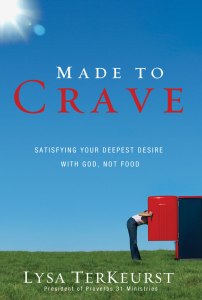
Book Review: Made to Crave by Lysa Terkeurst

made-to-crave1

I’m not a book reviewer. I just read this book and thought, “I should blog about it!”

So I’m calling it a book review but I think it a better classification might just be:

“My favorite parts of a book that I read that might be useful to my readers because it’s a book about food and healthy eating and females and Jesus.”

But that title would be really really long.

So let’s call it a book review and be done with it.

The gist: Made to Crave by Lysa TerKeurst has the subtitle: Satisfying your deepest desire with God, not food. From the back cover: “This book is not a how-to manual or the latest, greatest dieting plan. Made to Crave is a helpful companion to use alongside whatever healthy eating approach you choose- a book and Bible study to help you find the “want to” in how to make healthy lifestyle changes.”

There’s no discussion about paleo or veganism or eating certain foods. It’s not a diet book at all and that’s what attracted me to it initially. Also, the author is the President of Proverbs 31 Ministries which has nothing to do with fitness but everything to do with women and how to live awesome God-filled lives. Plus, her daily devotional kind of inspired me to start my own daily devotional blog (shameless plug!)

Back to the book – Lysa takes certain passages from the Bible and applies them to real life. It’s a book geared toward women (but men struggle too, I’m sure) and how we put so much pressure on ourselves to be these thin, skinny jean wearing fit females.  Basically, the lesson is – turn your cravings of food into a craving for God. Instead of trying to summarize the book, I’m going to outline some of my favorite parts. (I highlighted and underlined practically every chapter which goes to show to just how much I loved this book…and I think you females would be wise to pick it up).

Disclaimer: Lysa never suggests that you CAN’T have any treat EVER AGAIN. She actually believes what I believe: You can have a taste of sweets and cake on your birthday and all that…but probably not at first. Not until you learn self-control. You may have to abstain or cut out the junk for a “season” as she puts it (i.e. a long time) but when you have that self control, then you can re-introduce those treats back into your eating plan. But it takes time to learn and apply that self-control and discipline, no matter what “diet” you’re on.

  • If we want to conquer our cravings, we’ll have to redirect them to God.
  • Lysa discusses our “Want To.” In other words, we all know what to do to lose weight, don’t we? It’s the fact that we don’t “want to” change enough to do it. She says it’s about “recalibrating our souls so we want to change.” So she lists a few ways we need to Find our Want To:

1. SpirituallyShallow desires produce only shallow efforts. Seek a spiritual want to empowered by God Himself. In other words, don’t use the vanity seeking reasons to lose weight. That will only get you so far. Just saying “Oh I want to look good in a bikini” is a vanity seeking reason. Besides, who DOESN’T want to look good in a bikini? Dig deeper.

2. PhysicallyTurn those spiritual insights into practical choices. As I’ve mentioned a few times, our weight is a direct reflection of our choices and our health. Whatever spiritual perspectives we read about are awesome for our mind and our soul, but you have to put the healthy food choices into practice to make it work.

3. MentallyWe were made for more than compromise. We were made for God’s promises in every area in our lives. Stop settling and thinking: Well this is just the way I’m meant to be. I’m meant to be overweight, there’s nothing I can do about it so I might as well not even try.  Enough with the self-pity talk. We were made for more and we can do better than settling for garbage food and garbage quick fixes.

  • God, not food, is who is in control of me. Food can fill our stomachs, but never our souls.
  • We grow closer to God by learning the powerful principle of denying ourselves things that distract us and hold us back from following. We grow closer to God as we learn to look and act more and more like Him. The bible calls this participating in His divine nature.
  • As you go to get on the scale once a week – Define your week by obedience, not by a number on the scale.
  • Confession from the author that I thought was interesting and applicable to all of us: I depended on food for comfort more than I depended on God.
  • Embrace the benefits (of exercise) instead of resisting the hardship. (This is definitely worth an entire blog post in the near future)
  • There is a good reason we must face our temptations (food, addictions, drugs, sex, etc). The struggle to say no may be painful in the moment, but it is working out something magnificent within us. Asking ourselves, “This feels good now, but how am I going to feel in the morning?”
  • On Idolatry and Food: Expecting anything outside the will of God to satisfy us is idolatry. Nutrition, which is food’s intended purpose, means consuming proper portions of healthy choices that enable our bodies to function properly. Idolatry, in the case of food, means the consumption of ill-sized portions and unhealthy choices because we feel like we deserve it or need it to feel better. We are to flee the control food can have over our lives. If we flee from the pattern of idolizing food and stop depending on food to make us feel emotionally better, we will be able to more clearly see the way our God promises to provide when we are tempted.

There is so much more that I could quote as Lysa had countless examples of scripture that could be applied to so many situations we might find ourselves in as we attempt to eat healthy and lose weight. I might take a few of her examples and apply them to my other blog since I feel it might be more applicable there. (trying to keep my faith and fitness separate although, to me, they go hand in hand).

I highly encourage all women of faith to purchase this book, regardless of where you are in your journey to be healthy. The book was/is so popular, the author wrote a study guide and a ton of other resources to go along with it.

I read this book in less than a week. And anyone who knows me knows I don’t read that quickly unless I REALLY like a book so, for what it’s worth!


Things of This World

1 John 2:15-17

Do not love the world or the things of the world.
If anyone loves the world, the love of the Father is not in him.
For all that is in the world,
sensual lust, enticement for the eyes, and a pretentious life,
is not from the Father but is from the world.
Yet the world and its enticement are passing away.
But whoever does the will of God remains forever.


According to the Life Application Study Bible regarding this particular scripture: Some people think that worldliness is limited to external behavior – the people we associate with, the places we go, the activities we enjoy. Worldliness is also internal because it begins in the heart and is characterized by three attitudes:

1. sensual lust – trying to get our physical desires met outside the will of God

2. enticement for the eyes – coveting and accumulating things, bowing to the god of materialism

3. a pretentious life – obsession with one’s status or importance

By contrast, God values self-control, a spirit of generosity, and a commitment to humble service. It is possible to give the impression of avoiding worldly pleasures while still harboring worldly attitudes in one’s heart. It is also possible to love sinners and spend time with them while maintaining a commitment to the values of God’s kingdom.

Fit in your Faith Today: What do you value the most? Do you spend most of your time obsessing over worldly things? The things that you can’t take with you after you’re gone? Or do you spend most of your time valuing the most important things in life – generosity, spreading good, humbleness and self control?


The Word is Alive

John 1: 1-5, 9-14

In the beginning was the Word,
and the Word was with God,
and the Word was God.
He was in the beginning with God.
All things came to be through him,
and without him nothing came to be.
What came to be through him was life,
and this life was the light of the human race;
the light shines in the darkness,
and the darkness has not overcome it.
The true light, which enlightens everyone, was coming into the world.
He was in the world,
and the world came to be through him,
but the world did not know him.
He came to what was his own,
but his own people did not accept him.

But to those who did accept him
he gave power to become children of God,
to those who believe in his name,
who were born not by natural generation
nor by human choice nor by a man’s decision
but of God.
And the Word became flesh
and made his dwelling among us,
and we saw his glory,
the glory as of the Father’s only Son,
full of grace and truth.

Merry Christmas to all the children of God on this most blessed day, the day our savior was born!


Fit in your Faith Today:  Be sure to spend some quiet time after the gifts have been unwrapped, after the last sip of egg nog, after the final goodbye to relatives. Spend time in quiet prayer in awe and wonderment at the true meaning of what this day signifies to all of us and to you.

Worry Less, Pray More

Philippians 4:6-7

Don’t worry about anything; instead, pray about everything. Tell God what you need and thank him for all he has done. Then you will experience God’s peace, which exceeds anything we can understand. His peace will guard your hearts and minds as you live in Christ Jesus.

Are you a worrier? Would others describe you as someone who is always anxious and worrying about the problems in your life? I could be described as a worrier. But I kept hearing the same piece of advice being repeated to me over and over by various people: Give it to God.

At first you might scoff at it and think, “Give WHAT to God? My problems? How can that possibly help?” But the more you think about it, the more it makes sense. Worrying doesn’t really solve anything. What does? Well, praying about it can at least ease the tension. Once you speak the words of what is on your mind to God, even if you’re just praying out loud and not quite sure you think God is listening (He is) it really does help. You can actually feel the weight being lifted off your shoulders as someone else takes the burden.

A couple other key words in St. Paul’s letter to the Philippians above is THANK HIM. So many times we pray ASKING for God to provide us with something. The more important word we should remember when praying is to start off by giving thanks. Because no matter what is going on in your life, there’s someone out there who has an even bigger dilemma and it’s good to recognize that despite your current distress, someone else out there could use a prayer too. So Thank God for all you have and then ask him to take the burden off your shoulders. Ask Him for guidance to help you figure out what to do. Ask him to bring you peace and ease your mind of any anxiety.

Fit In Your Faith Today: Who or what are you currently worrying about? How can you ask God to bring you peace to your current situation?

Pray for Wisdom

Proverbs 8: 9-12

My words are plain to anyone with understanding, clear to those with knowledge.

Choose my instruction rather than silver, and knowledge rather than pure gold.

For wisdom is far more valuable than rubies. Nothing you desire can compare with it.

I, Wisdom, live together with good judgement. I know where to discover knowledge and discernment.

Wisdom should affect every aspect of our lives, from beginning to end. We should always strive to increase our wisdom, always willing to learn something new about our faith, about relationships, about life. Under God’s direction and guidance, we can attain all kinds of wisdom and knowledge.

As for the value of wisdom, Proverbs teaches us it’s far valuable than gold or silver and jewels. Our goal should never be to increase our wealth. If we keep our eye on the prize of wisdom, we’ll be far happier with the results.

Money and fame and material possessions have temporary effects. They will only give us satisfaction that lasts a short while. It’s far better to have a wealth of knowledge, than a wealth of money.

Fit in Your Faith Today: What can you learn about God today? What is He trying to teach you and how can you share this new found wisdom with others?

Chasing the Wind

Ecclesiastes 2:9-11

So I became greater than all who had lived in Jerusalem before me, and my wisdom never failed me. Anything I wanted, I would take. I denied myself no pleasure. I even found great pleasure in hard work, a reward for all my labors. But as I looked at everything I had worked so hard to accomplish, it was all so meaningless – like chasing the wind. There was nothing really worthwhile anymore.

The book of Ecclesiastes can be a depressing one as we read Solomon’s words on life. He was the wisest man in the world. Yet he lived a lot of his life away from God. So he wrote this book as a way to spare future generations the bitterness of learning through their own experience that life is meaningless apart from God.

Solomon summarized his many attempts at finding life’s meaning as “chasing the wind.”

In all our accomplishments, even the big ones, our good feelings are only temporary. We might get that promotion at work and that feels great. But then we have to work even harder to keep that job. Security and self-worth are found, not in these accomplishments, but far beyond them in the love of God. Think about what you consider worthwhile – where you place your time, energy, and money. Are you always on the lookout for what will make you happy? “Once I lose this weight, then I’ll be happy.”  “Once I get that job, then I’ll be content.”  “Once we can finally afford that new home, then our lives will be so much better.”

Really? Chances are, once all these things happen, you’ll find something else to shoot for and won’t be happy until that next goal is met. Don’t look back at your life and think that you, too were “chasing the wind.”  Above everything we should strive to know and love God. He gives wisdom, knowledge, and joy.

Fit In Your Faith Today: Take a look at where you put the majority of your efforts and energy. Are you yearning to know God? Or are you chasing the wind and searching for things that will only provide temporary satisfaction?


Spirit, Soul, and Body

The Second Reading for the Third Sunday of Advent is from 1 Thessalonians 5:16-24.

The last two verses are particularly interesting. It reads:

“May the God of peace make you holy in every way, and may your whole spirit and soul and body be kept blameless until our Lord Jesus Christ comes again. God will make this happen, for he who calls you is faithful.”

According to a Bible Study Guide on these two lines:

“The spirit, soul, and body refer not so much to the distinct parts of a person as to the entire being of a person. This expressions is Paul’s way of saying that God must be involved in EVERY aspect of life. It is wrong to think that we can separate the spiritual life from everything else, obeying God only in some ethereal sense or living for him only one day each week. Christ must control ALL of us, not just a “religious” part.

Thoughts on this reflection:

How often do we think “As long as I go to church, I’m good in God’s eyes.”  Or maybe we say “I pray everyday, I’m religious enough.”

Why do we cut God out from our lives and only let him in when it’s time to pray or go to Church? The key to keeping God close to our hearts is to know Him. We should study Him more than once a day. We should talk to Him more than once a week. He’s the reason we are alive. We, our spirits, souls and bodies, are living proof of His creation. We need to care for what we are given.

How do we do that?

Our SpiritsThis is defined as the “invisible, nonmaterial part of humans.”

How does someone take care of their spirit if they can’t even see it or feel it? Perhaps it’s just a feeling, an emotion. It’s the part of us that maybe only people looking at us can see or feel. Maybe it’s just one action or one smile or one act of caring and kindness that someone else looks at in us and thinks, “This person has a truly good spirit in them.” We feed our spirit good things by saying good things, nothing self-deprecating. We try to treat others as we want to be treated. When strangers see you performing good acts of kindness, you are showing them who God is. They will remember that and always remember what a good-heart and kind spirit you have.

Our Souls This is defined as the “inner life of a human being, the seat of emotions, and the center of human personality.”

Have you ever just looked at someone and thought you could see into their soul? Or maybe someone looked at you and you felt immediately a little uncomfortable, because you thought they could see a part of you that you wished they hadn’t seen? It’s our soul. Our “inner life” as it’s called. What does your soul look like? Are you happy with it or could it use a makeover? Are you doing harm to your soul by sinning and making poor decisions? Remember what St. Paul said, our souls should remain blameless until Christ comes again.  A priest once spoke about sin in this way: “Every time we sin, we disfigure our soul.”  We can take care of our souls by confessing our sins. Picture your soul becoming disfigured every time you knowingly and willingly choose to sin. That is an upsetting visual and sometimes it’s enough to get us to cease with sinning and start praying.

Our BodiesThis is our physical body, our “physical essence.” We take care of our bodies by honoring God with it. This means we don’t intentionally harm ourselves. We don’t purposely engage in behavior that puts our body in danger of getting hurt. Simply put, our body is a temple. We need to treat it as such. For many this means being physically fit, eating nutritious and healthy foods, getting plenty of rest and not putting our bodies in harms way. But honoring God with our bodies can be difficult for some. Addictions to food, drugs, alcohol, sex, pornography, and abuse can cause a lot of damage to our bodies (souls and spirits too!). The good news is we can reverse this process. We can surrender to God and give it all to Him if we have an addiction. He can set our path straight if we have taken a wrong turn. It’s never too late!

Fit in Your Faith Today: Honor God by doing one thing today that shows you are keeping your Body, Spirit and Soul blameless.